
TH-Wildau - News
Days of Ukraine 2026 - Former President Joachim Gauck at the Opening Evening: “Courage is a human possibility”
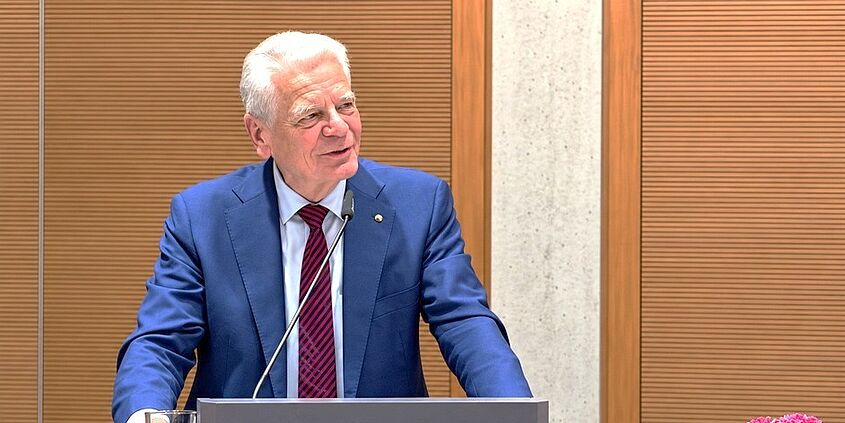
Berlin. The Days of Ukraine 2026 in Berlin-Brandenburg started on 7 October with an opening festive evening at the Representation of the State of Brandenburg in Berlin. Guests from academia, politics and diplomacy marked the tenth anniversary of the German-Ukrainian Academic Society (DUAG). This year’s Days of Ukraine were hosted by the Technical University of Applied Sciences Wildau (TH Wildau), where the programme on 8 and 9 October featured scientific talks, presentations of German-Ukrainian cooperation projects and discussions on the future of Ukrainian science.
In his speech “Do Not Follow Your Fears – Choose Courage” (in German), Gauck called for reliable support for Ukraine – humanitarian, financial, military and scientific. “Courage, ladies and gentlemen, is a human possibility,” he said. The work of DUAG, he noted, shows how academic contacts grow into stable partnerships. Gauck recalled Germany’s historical responsibility: during the Second World War, Ukraine was entirely occupied by Germany, yet its victims remain largely unknown in the West until today. Ukrainian researchers, he stressed, are not recipients of aid but equal partners. His greatest concern is that media and public attention will fade the longer the war goes on.
The welcoming addresses showed how much cooperation has grown since 2022. On behalf of the State of Brandenburg, State Secretary David Kolesnyk welcomed the guests, noting that almost all of Brandenburg’s universities now work with Ukrainian partners. Prof. Dr. Walter Rosenthal, President of the German Rectors’ Conference (HRK), spoke on behalf of the Alliance of Science Organisations in Germany. According to Rosenthal, the number of German-Ukrainian university partnerships has doubled to around 400 since the start of the full-scale invasion. Natalia Chernopaschenko, Counsellor at the Embassy of Ukraine, described Germany as her country’s largest research partner after the EU. At the same time, she warned that the displacement of researchers could turn into a permanent brain drain.
DUAG President Prof. Dr. Olga Garaschuk recalled the society’s founding in 2016 by 16 researchers, at a time when Ukraine was still “a blind spot on Europe’s mental map”. Today, DUAG has more than 120 active members and, among many other activities, has built an information and collaboration platform featuring 533 cooperation projects. Without a Ukrainian victory, Garaschuk said, neither security nor peace in Europe can be guaranteed.
“If Ukraine loses, we as Europe will have lost too,” said Prof. Dr. Ulrike Tippe, President of TH Wildau. Universities, she said, can build bridges in the pre-political sphere. What is needed is not short-lived projects but structural, sustainable cooperation.
Conference President Prof. Dr. Marcus Frohme (TH Wildau) described how close the war feels to him personally, recounting video calls with colleagues taking shelter from incoming missiles, and images of his former doctoral student’s house damaged in a drone attack.
The guests gave a warm applause to a delegation from Kharkiv National University of Radio Electronics (NURE), whose journey to Berlin took around two days.
The musical programme of the evening was performed by the outstanding musicians Olga Glibovych (violin) and Yaromyr Bozhenko (piano), who performed works by the Ukrainian composers Berezovsky, Lysenko and Barvinsky with great expressiveness and sensitivity.
The scientific programme of the Days of Ukraine began on 8 October at TH Wildau.
Day 2, 8 October: Quantum Alliance in Wildau, Academic Evening at the BBAW
Following a minute of silence for the victims of the war, the scientific programme opened on 8 October in Hall 17 at TH Wildau. The first highlight of the morning was the signing of a cooperation agreement between TH Wildau and Kharkiv National University of Radio Electronics (NURE), establishing the “Wildau – NURE Quantum IT Alliance” (WiN Q-IT Alliance). The alliance is linked to TH Wildau’s recently founded Quantum Application Hub and will in future also connect companies from the Kharkiv region, the district of Dahme-Spreewald and Berlin.
Around 30 presentations showcased the variety of German-Ukrainian research in the region: from an AI method for identifying war victims based on the sphenoid sinus, to cancer therapy using ultra-high dose rates at DESY in Zeuthen and AI-assisted rehabilitation, to the impact of the war on rivers and landscapes. Further sessions were dedicated to funding programmes of the DAAD and the Alexander von Humboldt Foundation, the Potsdam – Ivano-Frankivsk town twinning and the German-Ukrainian University Network, including the joint computer science degree programme CoSMoS-NT run by NURE and TH Wildau. “The freedom the people of Ukraine are fighting for is our freedom,” said Prof. Dr. Christian Stegmann, Director at DESY Zeuthen. A moving moment was the tribute to Dr. Mariya Shcherbyna, a researcher who had fled Kharkiv and passed away shortly before taking up a postdoctoral position at BTU Cottbus-Senftenberg.
At the Berlin-Brandenburg Academy of Sciences and Humanities (BBAW) the day continued with an academic gala evening. BBAW President Prof. Dr. Christoph Markschies reported on his trip to Lviv, and in a video message Nobel Peace Prize laureate Oleksandra Matviichuk recalled Russia’s deliberate attacks on schools, universities and libraries. Dr. Carolin Roeder emphasised on behalf of Brandenburg’s Minister of Science Dr. Manja Schüle: “We stand firmly by Ukraine’s side.” Following the DUAG PhD competition held at midday, awards were presented to Léo-Paul Barthélémy (Université de Lorraine), Viktor Golovii (Nord University / Taras Shevchenko National University of Kyiv) and Maria Grynevych (Justus Liebig University Giessen). Directed by Dr. Anna Grebinyk the panel discussion “Rebuilding Together” explored how emergency aid can be turned into lasting scientific structures. The emotional closure was the specially composed song “Kharkiv Sky”, performed by Prof. Dr. Alina Nechyporenko.
Day 3, 9 October: Ukrainian Studies, Forests and Disinformation
On 9 October, DUAG held its general assembly and reaffirmed its call for German-Ukrainian cooperation to be institutionally anchored; it also intends to join the European coalition supporting Ukrainian science. The European University Viadrina illustrated how long Ukraine had been overlooked in Germany: until 2021/22, there was not a single degree programme dedicated to Ukraine in the country. Since then, the Competence Network Interdisciplinary Ukrainian Studies has been building up research and teaching. The Eberswalde University for Sustainable Development presented its 20-year partnership with Ukrainian forestry universities and discussed how war-damaged forests can be restored in a more sustainable and resilient way.
The keynote was delivered by Ukrainian disinformation researcher Dr. Halyna Padalko (MIT): “Even if you don’t notice it, you are at war, because we all move in a space of cognitive warfare.” She showed how Russia uses artificial intelligence to make disinformation cheaper and more convincing – up to and including propaganda deliberately planted in the training data of language models.
Conclusion: “War” and “Resilience”
In his closing remarks, Conference President Prof. Dr. Marcus Frohme (TH Wildau) observed that the most frequently used word over the three days was probably “war”, followed by “resilience”. He expressed the hope that the Days of Ukraine would remain with participants “not only in their minds, but also in their hearts”. The Days of Ukraine 2026 concluded with a workshop on Ukrainian places in Berlin, as well as guided tours of the Wildau industrial campus and Königs Wusterhausen Palace.
More infomation
xternal communications contacts at TH Wildau:
Mike Lange / Mareike Rammelt
TH Wildau
Hochschulring 1, 15745 Wildau
Phone: +49 (0)3375 508 211 / -669
Email: presse(at)th-wildau.de
Text and photos: M. Mohammadifard