
Research Data Management
What are research data?Open areaClose area
Virtually all data generated during the research process is considered research data. The German Research Foundation (DFG) defines research data as follows:
“Research data includes, among other things, measurement data, laboratory results, audiovisual information, texts, survey results, objects from collections, or samples that are generated, developed, or analyzed during scientific work.”
Source: Guidelines for Ensuring Good Scientific Practice – DFG
What is research data management?Open areaClose area
FDM encompasses all activities and processes aimed at effectively and sustainably collecting, organizing, storing, securing, analyzing, and sharing research data. It covers the entire life cycle of research data, from data collection through data processing and analysis to long-term archiving and potential reuse.
FDM is becoming increasingly important in everyday scientific practice: It is part of the DFG’s guidelines for ensuring good scientific practice (the “DFG Code”), and funding agencies are increasingly requiring projects to include a data management plan for handling research data. Good research data management protects against data loss, facilitates collaboration, and increases the visibility of your research.
What are data management plans?Open areaClose area
Data management plans (DMPs) are now part of the requirements set by various third-party funding agencies. These are questionnaires designed to describe how research data will be handled before, during, and after the completion of a research project. What may initially seem like extra work can offer several benefits for your research:
- Enables access to funding
- Facilitates documentation and organization
- Simplifies the reuse of data
- Reduces the risk of data loss
Various resources and tools are available for creating DMPs. The RDMO-BB service is available to several state universities in Brandenburg, including TH Wildau. More information about the service and DMPs can be found here.
What is FAIR?Open areaClose area
FAIR is an acronym that stands for Findable, Accessible, Interoperable, and Reusable. These principles state that research data should be findable, accessible, interoperable, and reusable. All of this must always take place within the respective technical and legal frameworks. For example, if a dataset cannot be made publicly available without restriction for legal reasons, it is important to transparently disclose this fact.
Adhering to the FAIR principles increases the visibility and efficiency of research, makes findings more traceable, and facilitates collaboration.
Various issues arise when implementing these principles, such as choosing a suitable repository. Please feel free to contact us with this or any other questions.
Does my field of study have guidelines for working with FDM?Open areaClose area
Some disciplines already have policies in place for handling research data, such as the life sciences. A list of discipline-specific RDM policies is available at forschungsdaten.org.
Guidelines and Strategy for FDM at TH WildauOpen areaClose area
FDM-BB State Initiative
TH Wildau, along with other universities in Brandenburg, is a member of the FDM-BB (Research Data Management in Brandenburg) initiative. The initiative’s website provides an overview of its activities and achievements, as well as helpful tools and resources.
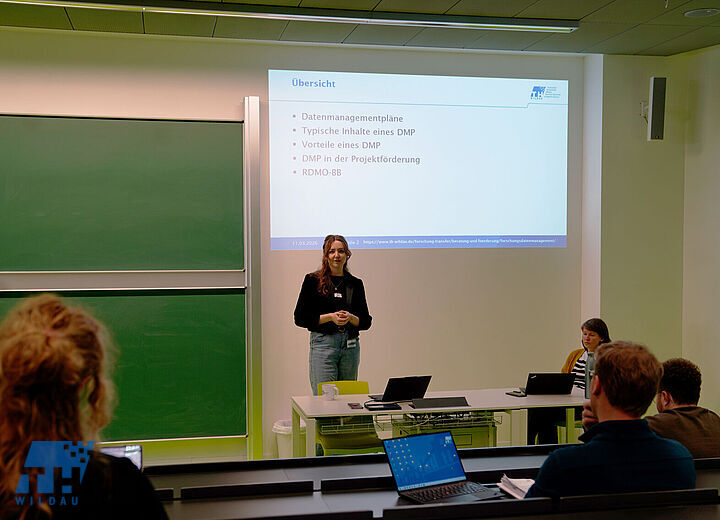
Review: Open Science Workshop as Part of Science Week 2026
At the Open Science Workshop on March 11, the ZFT and the university library presented selected open science topics in a practical manner as part of the 15th Wildau Science Week.
The focus was on ORCID as a personal identifier that helps uniquely identify your publications and research achievements and make them more visible; secondary publications in Open Access; the creation and management of data management plans using the RDMO-BB tool; and useful information on the publication of research data.
Review: FDM Fundamentals for Doctoral Students in the Brandenburg HAW Doctoral Program
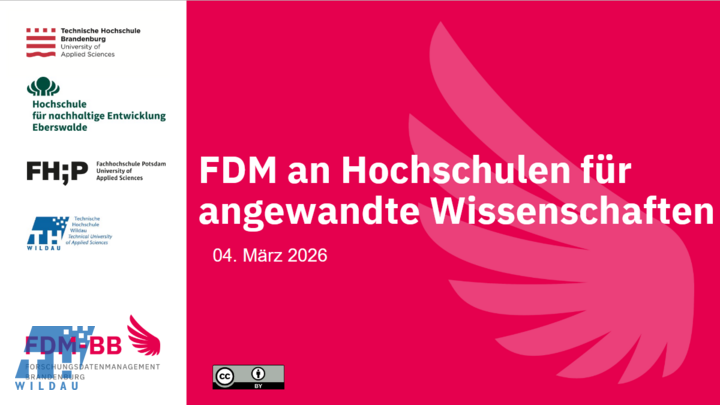
On March 4, 2026, an online course on research data management was held for doctoral students in the doctoral program of Brandenburg’s universities of applied sciences. Participants from the four universities of applied sciences gained foundational knowledge and information on active data management, publication, and archiving of research data, and were able to gain hands-on experience with data management plans (DMPs) and the DMP tool RDMO-BB during a concluding practical session.


FDM by Research Focus Areas
Under these links, you will find additional resources and links related to FDM, tailored to your specific research areas. These resources are continuously updated.
Related LinksOpen areaClose area
Further information on FDM:
- DFG Guidelines on Research Data Management (2015)
- Research Data Management Information Portal
- National Research Data Infrastructure
Additional research support from TH Wildau:
