
Doctorate
Early-career researchers
Pursuing a Ph.D. at TH Wildau
You can pursue a doctoral degree after completing a Master’s, Magister, or Diplom degree. During this process, you will develop an independent, innovative research project and, upon successful completion, earn a doctoral degree.
During your doctoral studies, you will be supervised by a primary advisor and a secondary advisor. You will choose the topic of your dissertation in consultation with your advisors. The rights and obligations of the advisors and doctoral candidates are set forth in a supervision agreement.
TH Wildau aims to provide greater support to researchers in the early stages of their careers and to facilitate doctoral studies in a systematic and structured manner. As a university of applied sciences, TH Wildau does not have its own right to award doctoral degrees. However, doctoral studies at TH Wildau can be conducted through partnerships with universities. TH Wildau has cooperation agreements with, among others, the Brandenburg University of Technology Cottbus-Senftenberg (BTU C-S) and the University of Tor Vergata in Rome, Italy. Admission, enrollment, the conduct of the doctoral program, the initial review, and the completion of the doctoral degree take place at a partner university. The doctoral regulations of the faculty at the participating university apply. These regulations also govern additional requirements for graduates of universities of applied sciences, such as supplementary qualification measures. The second supervisor is a professor at TH Wildau. The doctoral research is generally conducted there as well.
There are two options available for pursuing a doctoral degree at TH Wildau:
- Individual collaborative doctoral program
- Collaborative doctoral program within the structured doctoral program of the Graduate College
- (“Innovation and Career Center for Integrated Engineering” and “Career Center for Faculty Development”)
Joint Doctoral ProgramOpen areaClose area
At TH Wildau, joint doctoral programs are available in both departments. In such cases, the doctoral candidate is jointly supervised by a professor from TH Wildau and a professor from a university. Admission to the doctoral program and the initial review take place at the university, while the doctoral research is usually conducted directly at TH Wildau, where the second review also takes place.
The doctoral regulations of the relevant faculty at the participating university are decisive for the doctoral process. These regulations set forth the essential rules regarding admission, the conduct, and completion of the doctoral program, including the doctoral degree to be conferred. In addition, further requirements—such as an above-average undergraduate degree and any necessary preparatory courses, particularly for graduates of universities of applied sciences—are specified. Doctoral candidates are usually enrolled as doctoral students at the respective university.
The dissertation topic should be a research question derived from the current state of research that is scientifically relevant and offers a novel contribution. The topic may, for example, be derived from a previous thesis or the candidate’s own interests, or it may be announced by relevant research groups. The topic should be agreed upon in consultation with potential advisors. Suitable university partners can be identified based on the methodological approach or through existing contacts at TH Wildau. Concrete cooperation agreements for the systematic implementation of cooperative doctoral programs are in place with two universities: Tor Vergata University of Rome and BTU C-S.
The key points of the collaboration within the doctoral program should be set forth in writing in a supervision agreement between the supervisors and the doctoral candidate.
Funding for a collaborative doctoral program can be secured in various ways—e.g., through a third-party funded project, a doctoral fellowship, or participation in a research training group.
If you are interested in pursuing a doctoral degree at TH Wildau, please contact a professor at TH Wildau who works in the relevant field of study.
We are happy to answer any general questions you may have.
Orientation Week – Navigate your PhD-Project | March 2 - 6, 2026 | DE/ENOpen areaClose area
Powered by Promotionskolleg der brandenburgischen HAWs / Brandenburg Graduate School for Applied Sciences
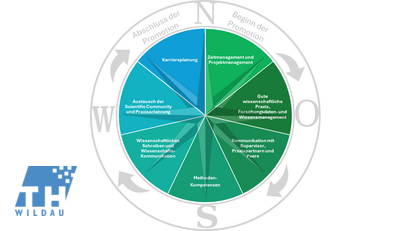
If you plan your PhD-Journey or just need some new inspiration for your research-adventures, the new programme of the "PhD Compass" is open for all: prospective PhD candidates*, PhD-students* and PostDocs.
*If you plan to do your PhD with the new “Brandenburg Graduate School for Applied Sciences”, the offered courses may be obligatory for you. Please navigate your course programme with the illustrated PhD Compass or ask your advisor for academic career development.
There are a limited number of spots in the workshops, so it is a good idea to sign up quickly. The idea behind the Orientation Week is to give PhD students a comprehensive set of essential tools over the course of a week. However, depending on your interests, you can also book individual workshops.
We look forward to receiving your registrations by February 15, 2026 at this link:
https://eveeno.com/orientationweek2026
And without further ado, here is the exciting programme for this amazing week that puts the fun in research f(o)undations:
Monday: Foundation of a good research journey
Title: Good Scientific Practice
Venue: Online
Course language: English
Time: 9 am – 4:30 pm
Abstract: Good scientific practice is the foundation of reliable research and scientific progress. In this interactive workshop, you will become familiar with core principles of good scientific practice and examine your role and responsibilities as a researcher. Discussion of case studies and exchange with colleagues will offer opportunities to connect abstract norms with your everyday research practice. Throughout the day, we will reflect on research culture, grey zones and individual dilemmas, and on generative AI as a challenge and potential for good scientific practice.
Tuesday: How to communicate with the whole PhD crew
Titel: Setting the course for a successful Doctorate
Venue: Berlin Global Village, Am Sudhaus 2, 12053 Berlin
Course language: English
Time: 9 am – 4:30 pm
Abstract: The workshop supports doctoral researchers in gaining orientation, clarity, and confidence at an early or critical stage of their PhD. It introduces key phases of the doctorate and common challenges, and invites participants to reflect on their motivation and goals and how these shape their PhD process. Participants take a holistic view of their doctoral journey, identify personal, social, and institutional resources, and reflect on their supervision situation. Practical guidance is offered on building constructive supervisory relationships and complementary support structures. Overall, the workshop helps participants set a clear and realistic course for a successful, sustainable, and self-directed doctorate.
Wednesday: How to navigate the wide sea of data
Title: Research data management
Venue: Online
Course language: German
Time: 9 am – 4:30 pm
Abstract: Discover how to organise your research data efficiently, securely, and sustainably during the introductory day on research data management. Learn about standards, tools, and best practices that can simplify your day-to-day research work and enhance the quality of your results. Our experts provide hands-on insights ranging from planning a professional approach to research data management to data archiving and publication. Take the opportunity to ask questions and exchange ideas with colleagues. Start well informed with professional and secure research data management.
Thursday: How to navigate myself and a doctorate?
Title: Time and Self-Management
Venue: Online
Course language: German
Time: 9 am to 17 pm
Abstract: The doctoral phase requires a high degree of independent work and perseverance. Losing track, getting bogged down, not finding enough time for the project, progressing too slowly or feeling overwhelmed are classic difficulties. There are many reasons for this. Classic examples include the balancing act between working on your dissertation and other academic tasks or your day job, working independently, procrastination, the complexity of the project, or dwindling motivation. The workshop will help you to plan your dissertation well, work productively, and tailor it to your individual needs.
Friday: How the journey continues
Venue: Online
Course language: English / German
Time: 1-2 pm
Coffee Break with Feedback as well as annual planning with the question “What do you really need?“
PromotionskompassOpen areaClose area
Graduate Research Training Program at TH WildauOpen areaClose area
TH Wildau aims to facilitate doctoral studies in a systematic and structured manner and is continuously expanding the Graduate College at the university to this end. Innovation and Career Centers (e.g., IKC IE, see below) focus on specific research areas but are scalable at any time and open to additional research areas that may emerge in the future. The Career Center for Professorial Development also brings together a wide variety of advisory and support services for a career path leading to a professorship at a university of applied sciences.
The disciplinary and interdisciplinary offerings of the Graduate College complement those of the university where the doctoral candidates are enrolled. The added value of these offerings lies in their practical relevance, application-oriented research, and the special importance of knowledge and technology transfer. Doctoral candidates can network with one another within the Graduate College and acquire additional qualifications. Ultimately, the goal is for all individuals pursuing a doctorate at TH Wildau to complete the structured doctoral training program in the Graduate College and benefit from its added value.
Steering CommitteeOpen areaClose area
The steering committee is responsible for academic quality assurance in doctoral programs within the Graduate College at TH Wildau that are based on employment contracts established for the purpose of pursuing a doctorate (doctoral or training positions). Quality assurance for cross-university innovation and career centers is carried out by steering committees formed within those centers (e.g., IKC IE, see below).
The interdepartmental steering committee is responsible for deciding on the allocation of doctoral or qualification positions, supporting the selection of research topics, guiding the doctoral procedures, and monitoring the progress of the doctoral work.
The steering committee’s operating procedures are governed by a set of rules of procedure (link).
The steering committee consists of the following members, each with one voting voice:
- Prof. Dr. Kathrin Bösener, Department of Economics, Computer Science, and Law
- Prof. Dr. Ute Geißler, Department of Engineering and Natural Sciences, Chair of the Steering Committee
- Prof. Dr. Sandra Haas, Department of Economics, Computer Science, and Law
- Liane Kober, M.Sc., Department of Engineering and Natural Sciences
- Dr. Tobias Kutzner, Department of Economics, Computer Science, and Law, Vice Chair of the Steering Committee
- Prof. Dr. Carolin Schmitz-Antoniak, Department of Engineering and Natural Sciences
Member with voting rights in the case of the qualification positions associated with the BMBF funding line “FH Personal”:
- Susanne Voltmer, Career Center for Professorial Development
Integrated Engineering Innovation and Career Center (IKC IE)Open areaClose area
The “Innovation and Career Center for Integrated Engineering” (IKC IE) is a graduate research training program that offers a structured doctoral program in the field of engineering. Upon successful application, participants receive funding for the duration of their doctoral project. They take part in workshops and continuing education courses and receive close guidance throughout the doctoral process, including through
- Supervision Agreement: Rights and obligations of doctoral candidates and advisors
- Doctoral Logbook: Continuous documentation and reflection on the doctoral process
- Regular Journal Club: Interdisciplinary exchange and clarification of questions
- Annual Meetings: Presentation of doctoral progress to the steering committee
- Conferences and publications in academic journals: Presentation of research results to the scientific community
- Design and implementation of courses
- Continuing education: interdisciplinary key competencies
The IKC IE is a collaboration between the Technical University of Applied Sciences Wildau (TH Wildau), the Eberswalde University for Sustainable Development (HNEE), and the Brandenburg University of Technology Cottbus-Senftenberg (BTU C-S). It is funded by the State of Brandenburg.
There are currently no doctoral positions advertised at the IKC IE.
For questions about the IKC IE, please contact: graduiertenkolleg(at)th-wildau.de
Organization of the IKC IEOpen areaClose area
- Coordination
- Dr. Beate Schappach
- Spokesperson
- Prof. Dr. Ute Geißler
- Steering Committee
- Prof. Dr. Klaus-Martin Melzer (THW)
- Prof. Dr. Michael Hübner (BTU)
- Prof. Dr. Alexander Pfriem (HNEE)
Associate Professors at the IKC IEOpen areaClose area
TH Wildau
- Prof. Dr. Peter Blaschke
- Machine Dynamics and Low-Noise Design
- Prof. Dr. Andreas Foitzik
- Microsystems Engineering
- Prof. Dr. Ute Geißler
- Materials Science
- Prof. Dina Hannebauer
- Machine Dynamics and Acoustics
- Prof. Dr. Michael Herzog
- High-Performance Polymer Materials
- Prof. Dr. Andreas Mai
- Micro-/Nanoelectronics
- Prof. Dr. Dana Mietzner
- Innovation and Regional Management
- Prof. Dr. Jörg Reiff-Stephan
- Applied Computer Science in Mechanical Engineering
HNE Eberswalde
- Prof. Dr. Silke Lautner
- Applied Biology of Wood
- Prof. Dr. Alexander Pfriem
- Chemistry and Physics of Wood and Chemical Process Engineering
- Prof. Dr. Ulrich Schwarz
- Design, Construction, and Manufacturing of Wood Products
BTU Cottbus-Senftenberg
- Prof. Dr. Matthias Ziegenhorn
- Numerical Methods in Nonlinear Solid Mechanics
Ph.D. students at the IKC IEOpen areaClose area
Ph.D. Candidate / Thesis Title / Advisor / Partner University
- Norman Günther
- Model of a Dynamic Socio-Cyber-Physical Production System for Human-Centered Process Control
- Prof. Dr. Ulrich Berger (BTU), Prof. Dr. Jörg Reiff-Stephan (THW)
- Brandenburg University of Technology Cottbus-Senftenberg
- Robert KamenzkyInvestigation of a Method for Precise Noise Identification in Track-Bound Transportation SystemsProf. Dr. Peter Blaschke (THW), Prof. Dr. Ennes Sarradj (TU Berlin)
- Technical University of Berlin
- Robin Pianowski
- Investigation of wear detection based on natural frequency shifts in tram wheel tires
- Prof. Dr. Dina Hannebauer (THW), Prof. Dr.-Ing. Sylvio Simon (BTU)
- Brandenburg University of Technology Cottbus-Senftenberg
- Bastian Prell
- Acceptance, Use, and Diffusion of Digital and Industrial Methods in the Skilled Trades (successful defense on August 21, 2025, magna cum laude)
- Prof. Dr. Christiane Hipp (European University of Flensburg), Prof. Dr. Jörg Reiff-Stephan (THW)
- Brandenburg University of Technology Cottbus-Senftenberg
- Francesco Villasmunta
- Optical Through-Silicon Waveguides for 3D Chip-to-Chip Interconnections
- Prof. Dr. Andreas Mai (THW), Prof. Dr. Harald Schenk (BTU)
- Brandenburg University of Technology Cottbus-Senftenberg
Additional InformationOpen areaClose area
- Hochschulkompass—a service provided by the German Rectors’ Conference: www.hochschulkompass.de/promotion.html
- The Guide to Doctoral Studies on academics: www.academics.de/themen/promovieren
-
Early-career researchers at TH Wildau can take advantage of interdisciplinary continuing education programs offered by partner universities
- Potsdam Graduate School: www.uni-potsdam.de/de/pogs/
- Graduate Research School BTU Cottbus-Senftenberg: www.b-tu.de/researchschool/
- Brandenburg Network for Quality in Higher Education (sqb): www.faszination-lehre.de
-
Good Scientific Practice
- 1. Amendment to the Statutes for Ensuring Good Research Practice at TH Wildau: www.th-wildau.de/files/2_Dokumente/Amtliche_Mitteilungen/27_2024_LV_1Aend_Satzung_DFG_Kodex_01.pdf
- Ombudsperson for Ensuring Good Research Practice at TH Wildau: www.th-wildau.de/thinsights/prof-iciar-dominguez-lacasa-zur-ombudsperson-fuer-die-sicherung-der-wissenschaftlichen-praxis-bestellt/
- Ombudsman for Research at the German Research Foundation (DFG): ombudsman-fuer-die-wissenschaft.de
- Plagiarism Prevention: www.th-wildau.de/hochschule/zentrale-einrichtungen/hochschulbibliothek/schulungen-und-beratungsangebote/gute-wissenschaftliche-praxis-und-plagiatspraevention/
-
Research Data Management
- Research Data Management Brandenburg: fdm-bb.de
- Research Data.info Information Platform: forschungsdaten.info
-
Funding Opportunities
- Job Postings at TH Wildau: www.th-wildau.de/hochschule/jobs-und-karriere/stellenangebote/
- Search for Foundations: stiftungssuche.de
- German Academic Exchange Service (DAAD): www.daad.de
- German Research Foundation (DFG): www.dfg.de
-
Publications
- TH Wildau Publication Fund: www.th-wildau.de/hochschule/zentrale-einrichtungen/hochschulbibliothek/open-access-und-publikationsdienste/publikationsfonds/
- Introduction to Open Access: open-access.network/startseite
- Brandenburg Open Access Networking and Competence Center: open-access-brandenburg.de
- Database of Open Access Journals: doaj.org
- Open Researcher and Contributor ID as an internationally recognized identifier for researchers: orcid.org
Archive | Completed Collaborative Doctoral ProjectsOpen areaClose area
2023
- Sascha Morlock
- Modification of electrode surfaces with photoactive proteins to generate a photocurrent and synthesize valuable substances via enzyme coupling
- Prof. Dr. Fred Lisdat
- Humboldt University of Berlin
- Philipp Schrauth
- Agglomeration, air quality, and urban transformation
- Prof. Dr. Ronny Freier
- University of Potsdam
- Andreas Walter
- Final Reserve Fuel Optimization
- Prof. Dr. Stefan Kubica
- Tor Vergata University of Rome
2022
- Jan MillauerDevelopment and validation of a binder-based mobile contaminant detectorProf. Dr. Andreas FoitzikTor Vergata University of Rome
- Erik KrumnowAutoinjection system for non-medical personnel in hazardous environmentsProf. Dr. Andreas FoitzikTor Vergata University of Rome
- Ron van de SandModel for Predictive Maintenance and Fault Type Detection in Multi-Vendor Industrial Refrigeration SystemsProf. Dr. Jörg Reiff-Stephan, Tor Vergata University of Rome
- Matthias BieberbachPlane Gain – Does a Corporate Jet Pay Off?Prof. Dr. Stephan Kubica, Tor Vergata University of Rome
- Vasileios VerverisInternet Censorship in the EU: A Technical AnalysisProf. Dr. Benjamin FabianHumboldt University of Berlin
2021
- Anna GrebynikSynergistic Chemo- and Photodynamic Treatment of Cancer Cells with C₆₀ Fullerene NanocomplexesProf. Dr. Marcus FrohmeJulius Maximilian University of Würzburg
- Franziska GlösOptimization of the energy transfer coefficient using a sample from a heater-cooling unitProf. Dr. Andreas Foitzik, Tor Vergata University of Rome
- Susanne SchlegelConstruction of a miniaturized blood sampling systemProf. Dr. Andreas Foitzik, Tor Vergata University of Rome
- Andreas EngelsOpen-source 3D bioprinterProf. Dr. Andreas Foitzik, Tor Vergata University of Rome
- Volker SchlegelConstruction of a 3D printer for the production of customized organoidsProf. Dr. Andreas FoitzikTor Vergata University of Rome
- Dominik HügleSchool-to-work transitions and labor market outcomesProf. Dr. Ronny FreierFreie Universität Berlin
2020
- David MarehnReliability of Data Acquisition and Processing Approaches for Chromatography Detection Systems in PharmacyProf. Dr. Heike Pospisil, Tor Vergata University of Rome
- Josefine Johanna GottschalkElectronic Speckle Pattern Interferometry for Cancer ResearchProf. Dr. Andreas FoitzikTor Vergata University of Rome
- Dimitri CiorniPerformance-oriented strategies for the integration and wiring of photosystem I within 2D and 3D architectures and coupling with enzymatic catalysisProf. Dr. Fred LisdatHumboldt University of Berlin
- Barbara LeszynskaFabrication of Monolayers and Solar Cells in the Very High-Frequency (VHF) Plasma Excitation Range and Layer DiagnosticsProf. Dr. Sigurd SchraderDresden University of Technology
- Josephat Kipyegon TanuiDetailed Study of Wood Combustion in a Fixed-Bed ReactorProf. Dr. Michael HerzogDedan Kimathi University of Technology, Nyeri, Kenya
- Thomas JacobVehicle Data Intelligence: Situation Detection in Cars Using DataProf. Dr. Stefan Kubica, Tor Vergata University of Rome
2019
- Heike KagelLight-Induced pH Cycle: A Non-Invasive Method to Control Biochemical ReactionsProf. Dr. Marcus Frohme, University of Potsdam
- Andrè LeschkeAlgorithm Concept for Crash Detection in Passenger CarsProf. Dr. Stefan Kubica, Tor Vergata University of Rome
- Yen HoangFeature Engineering: A De Novo Binning Strategy to Analyze and Visualize Multidimensional Cytometric DataProf. Dr. Peter Beyerlein, University of Potsdam
- Katja LohmannVehicle Data IntelligenceProf. Dr. Frank Dieter Sistenich, Chemnitz University of Technology
- Lars RadkeEvaluation of the Potency of Glycosylated Vaccines Using the RSV-F Protein as an ExampleProf. Dr. Marcus Frohme, Charité Berlin
- Jan-Patrick CapManagement of Innovation Networks with a Focus on Collaboration. A Method for Integrating Organizational and Analytical Perspectives on Networks Using the Example of Research and Technology Organizations Prof. Thomas Knothe, Technical University of Berlin
2018
- Benjamin BrunsThree Essays on Labor and Political Economy Prof. Dr. Ronny Freier, Humboldt University of Berlin
- Verena GrassThe Aftermath of Financial Crises and Natural Disasters on the Public Prof. Dr. Ronny Freier, Freie Universität Berlin
- Andreas FrahmUnmanned Aerial System for Environmental Research Under Extreme Ambient Conditions Within a Volcanic Ash Cloud Prof. Prof. Wolfgang Rüthner-Kindel, Tor Vergata University of Rome
- Marc RiedelPhotonic Wiring of Enzymatic Reactions to Photoactive Entities for the Construction of Biohybrid Electrodes Prof. Dr. Fred Lisdat, University of Potsdam
- Thilo LiebscherAffinity viscosimetry sensor for enzyme-free detection of glucoseProf. Dr. Andreas Foitzik, Tor Vergata University of Rome
- Felix SchützeProduct engineering for miniaturized, low-cost flow-through devicesProf. Dr. Andreas Foitzik, Tor Vergata University of Rome
- Sylvio SchneiderSmartphone-based quantitative lateral flow assay readerProf. Dr. Andreas Foitzik, Tor Vergata University of Rome
- Tarun Teja MallareddyThe Brake Pad Impedance Test MachineProf. Dr. Peter BlaschkeTor Vergata University of Rome
- Sven AngermannInvestigations of propeller optimization using propletsProf. Dr. Wolfgang Rüther-KindelTor Vergata University of Rome
2017
- Christian RoggeIn-situ pH measurement system for microbioreactorsProf. Dr. Andreas FoitzikTor Vergata University of Rome
- Roberto LiskerTwo-Phase Flow in Friction TurbinesProf. Dr. Udo Hellwig & Prof. Dr. Franz WildenauerTor Vergata University of Rome
- Jens FischbachIsothermal Amplification Methods for DNA- and Pyrophosphate-Dependent Pathogen DetectionProf. Dr. Marcus FrohmeUniversity of Potsdam
- Kai StiegerNanobionic Strategies for the Implementation of Photosystem I into Biohybrid PhotoelectrodesProf. Dr. Fred LisdatHumboldt University of Berlin
- Andrey MatevGlass-Fiber-Reinforced Composite Materials Based on Aqueous Polyurethane Acrylate DispersionsProf. Dr. Michael HerzogUniversity of Chemical Technology and Metallurgy, Sofia
- Jens KolbeEnhancing the understanding of urban economics by refining the spatial dimensionProf. Dr. Ronny Freier, Technical University of Berlin
- Eunah WhangSocial Security and Labor Markets in GermanyProf. Dr. Ronny Freier, Free University of Berlin
- Sebastian SchmitzEssay on Uncertainty and Public PoliciesProf. Dr. Ronny Freier, Free University of Berlin
- Ingo HeinrichA Planned Approach to Unscheduled Maintenance of Railway Vehicles—Paradox or Opportunity? Prof. Dr. Klaus-Martin Melzer, Technical University of Berlin
- Thorsten MartinAdvances in Spatial Econometrics and the Political Economy of Local Housing Supply—Essays in Regional and Political Economics Prof. Dr. Ronny Freier, University of Potsdam
- Markus GrohmeMolecular Adaptations to Anhydrobiosis in the Tardigrade Milnesium tardigradumProf. Dr. Marcus FrohmeUniversity of Potsdam
2016
- Kai-Henning LietzauElectronic Speckle Pattern Interferometry for Cancer ResearchProf. Dr. Andreas FoitzikTor Vergata University of Rome

Contact person
Dr. Beate Schappach
+49 3375 508 698
graduiertenkolleg(at)th-wildau.de
Hochschulring 1, House 13, Room 028, 15745 Wildau