
ScienceBox
Forschung sichtbar machen
Der Showroom der TH Wildau – Forschung zum Anfassen und Erleben
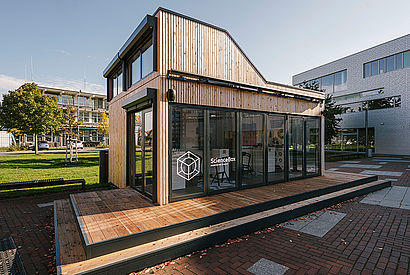
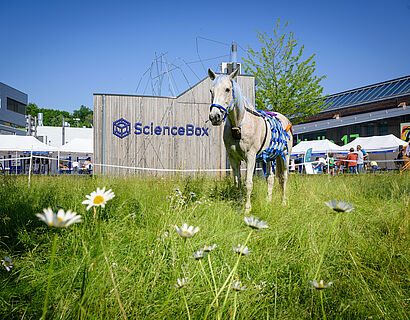
Centrally located on the campus, the ScienceBox serves as a showcase for the university’s research and knowledge transfer potential, presenting projects and topics in an innovative way: interactive, easy to understand, and tangible! It is a meeting place, and thanks to its technical equipment and central location, it is an ideal venue for events and presentations—whether digital or in person!
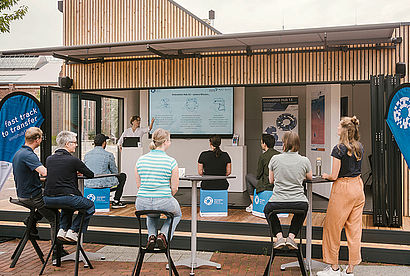
A venue for presentations and events
The ScienceBox is perfectly equipped for events: a large screen serves as a presentation area. The display stands double as lecterns or side tables. The rotating interior walls allow for a variety of spatial configurations.
For larger events during the warmer months, the glass facade can be opened to expand the space. The ScienceBox thus becomes a stage for the campus and a large audience.
Or would you prefer something more intimate? In addition to presentations, the space can also host “fireside chats” or small discussion groups in a closed room for up to eight people. Thanks to the available technology, these smaller workshops can also be held in a hybrid format.
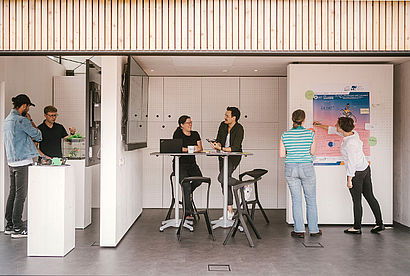
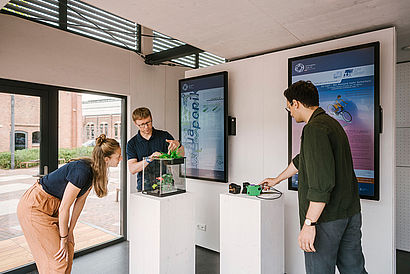
Here, research is showcased in the form of:
- Demonstrators
- Videos
- Posters
- Presentations
- Audio content
- and hands-on activities
A Space for Exchange and Collaboration
The ScienceBox’s technical equipment can be used for video calls, podcast recordings, or creative collaboration. Not only are the existing modern touchscreens, webcams, and PCs ideal for this, but you also have the option to connect your own devices. A sufficient number of outlets provide power and data connections for devices such as laptops, tablets, VR equipment, or printers. The rotating walls also allow you to flexibly adjust the room layout and customize it to your specific needs. The flexible co-working tables, where you can collaborate while standing or sitting, can accommodate up to eight people.
Current news in the ScienceBox
Design a flying machine!Open areaClose area
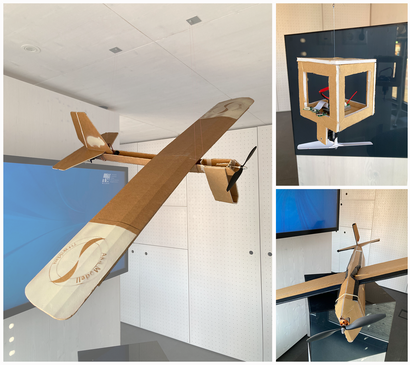
Students in the “Aviation Propulsion” lecture worked in teams to develop simple flying machines that had to be tested under real-world conditions. The task: Build a flying machine that flies for at least 30 seconds, is reusable, and enables stable flight using the simplest of means. The exhibits showcase the wide variety of solutions that were developed.
Academic Contact:
Prof. Dr. rer. nat. Andreas Deutschmann
January 2026 – August 2026
5G Rover | Using Artificial Intelligence to Ensure Runway SafetyOpen areaClose area
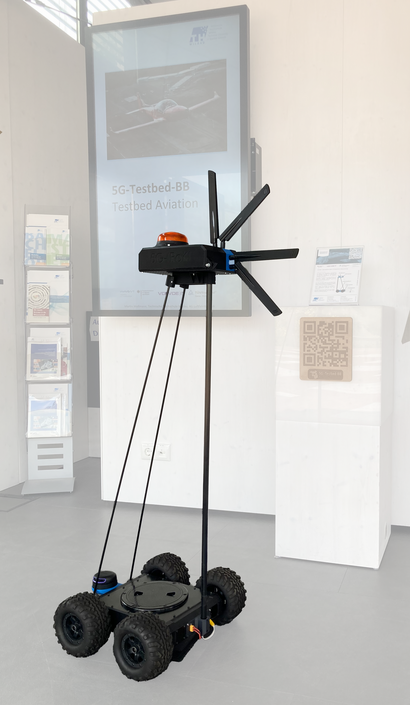
Runways at airports must be free of foreign objects, as these pose a safety risk. At Schönhagen Airport, the 5G Rover is being used to test how an automated system, supported by artificial intelligence, can handle the inspection of airport operational areas.
The camera mounted on the rover transmits image data via a local 5G network to a neural network for analysis, which performs automated object recognition with AI support. The 5G rover on display here is the “little brother” of a prototype located at Schönhagen Airport.
Technical Contacts:
Prof. Dr. Wolfgang Rüther-Kindel
May 2025 – October 2025
Are you interested in using the ScienceBox?
Feel free to request an exhibition space at our ScienceBox. This will allow you not only to test your own applications but also to receive valuable user feedback on them right away. You’ll also benefit from our support in tailoring your research and outreach content to your target audience.
Archive | Brief overview of previously featured themes and exhibits
HyPhoX | Rapid Digital Tests Using Photonic BiosensorsOpen areaClose area
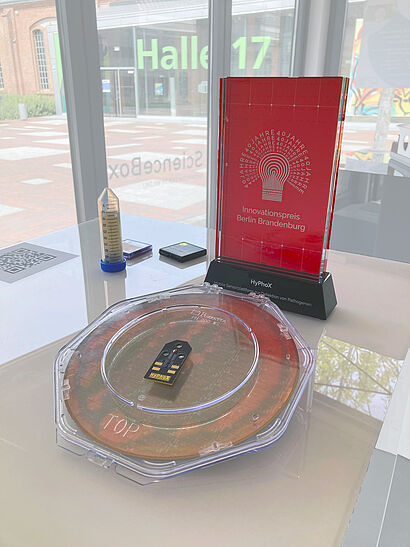
The startup HyPhoX develops digital rapid tests that enable on-site analyses with laboratory-grade accuracy. Using patented Photonics biosensors optimized for mass production, the company can detect bacteria, viruses, or proteins in liquids such as water, blood, and urine in just a few minutes. The award-winning spin-off brings together the advantages of Photonics, electronics, and biochemistry on a single microchip for the first time.
Technical contacts:
Prof. Dr. rer. nat. Andreas Mai
June 2024 – November 2024
ESPEK | AI-powered damage detection on trainsOpen areaClose area
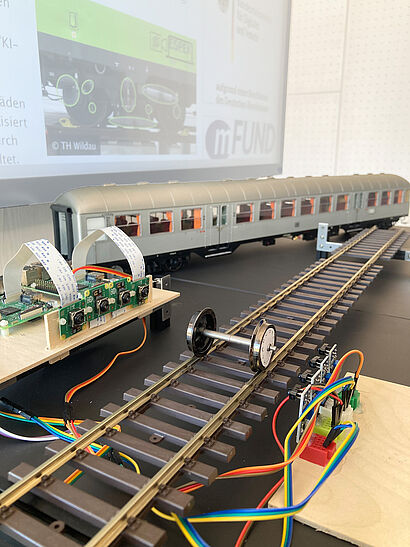
How can damage to passenger trains be detected automatically, ideally while the train is passing by? This question was addressed in the ESPEK project—Detection of Damage Patterns on Passenger Trains and Evaluation of Confidence in the Selection of Robust Features for “Predictive Maintenance.”
For various components (brake discs, brake pads, electromagnetic track brakes, wheel-shaft connections), the project identified which types of damage have been detected by humans to date and how these processes can be digitized and automated using computer vision tools (classical image analysis, deep learning).
Using a rotating wheel set as an example, the exhibit demonstrates how data can be consistently collected and standardized, which serves as the starting point for applying algorithms for anomaly detection—for example, to detect crack patterns on a brake disc.
Technical Contacts:
Lars Schymik
July 2024 – November 2024
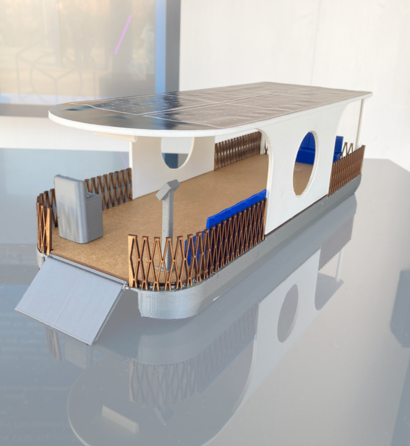
WIFAIR | Wildauer Ferry: Automatic, Intelligent, Renewable (*)Open areaClose area
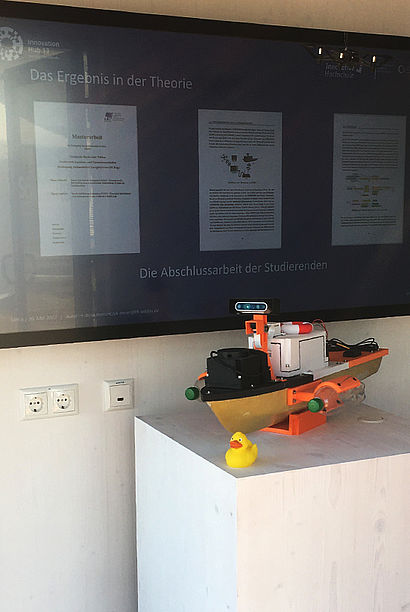
The exhibit showcases a concept study of a CO2-neutral autonomous ferry that has the potential to improve passenger transport on the Dahme River between Niederlehme and Wildau. In a preliminary study, the solar-powered boat developed by TH Wildau was upgraded with AI technology and control systems, enabling it to complete a test course fully autonomously and without a crew. The goal of the ongoing work is to develop a low-emission and reliable transportation solution for waterways.
Technical Contact:
February 2024 – May 2025
(*) For trademark reasons, the project was renamed in July 2025. The previous title was “CAPTN | CO2-Neutral Autonomous Ferry for Passenger Transport in Niederlehme.”
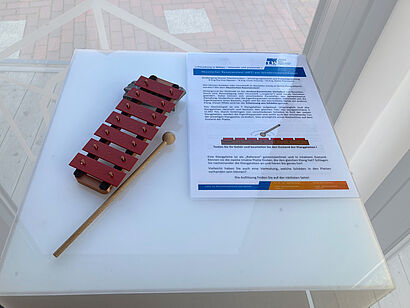
Acoustic Resonance Test for Damage Identification | Hands-On DemonstratorOpen areaClose area
Damage or wear to components alters their structural-dynamic behavior. These changes are audible and can be used to identify damage.
This demonstrator was built in the master’s course “Vibration Technology and Product Design” and allows students to experience firsthand which types of damage in an otherwise identical component lead to audible changes.
Stop by and test your hearing!
Technical Contacts:
Robin Pianowski,
Prof. Dr. Dina Hannebauer
May 2024 – October 2024
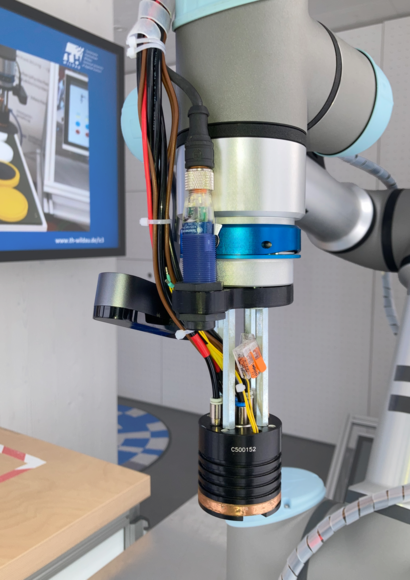
Freezer-Gripping Robot | A New Approach to Textile MaterialsOpen areaClose area
The freeze-gripping robot is a student-built demonstrator from the “iC3@Smart Production” research group led by Prof. Jörg Reiff-Stephan, and it showcases an innovative gripping mechanism for so-called flexible materials (e.g., textiles). First, a thin film of water is sprayed onto the material to be gripped, and this film is then frozen—this allows the robot to transport the materials without damaging them.
Technical contact:
November 2023 – June 2024
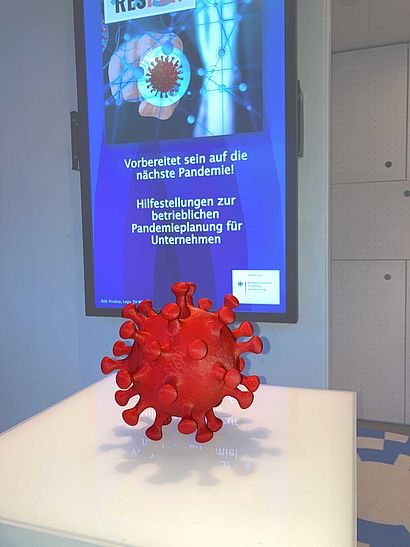
ResPan | Research for Corporate Pandemic PlanningOpen areaClose area
In the research project “RESPAN—Analysis of the REaliSation and Effectiveness of Corporate PANdemic Planning in the Context of the COVID-19 Crisis,” existing pandemic plans in small and medium-sized enterprises (SMEs) as well as critical infrastructure organizations were analyzed. In addition, new templates and guidelines were developed and made available to companies. The pandemic plan generator developed during the project by the Secure Object Identity Research Group helps companies quickly create an initial pandemic plan and adapt it to their individual needs.
Technical contacts:
December 2023 – March 2024
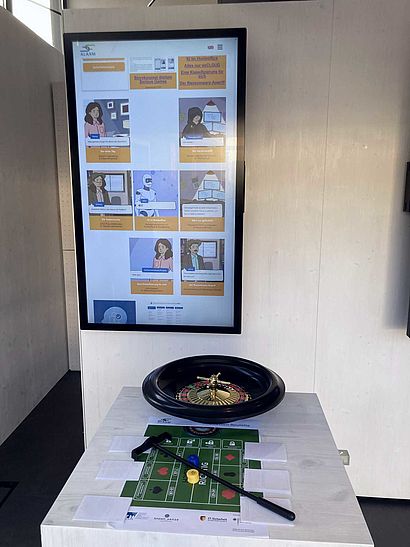
IT Security | Learning in the “Information Security Awareness Laboratory"Open areaClose area
As part of the ALARM - Awareness Lab for SME Information Security project, analog and digital games were developed to help small and medium-sized enterprises raise their staff’s awareness of various aspects of information security. Prof. Margit Scholl and her team developed a total of 14 so-called serious games to convey information through a playful approach and foster awareness of a sustainable information security culture.
Technical Contact Persons:
Prof. Dr. Margit Scholl
September 2023 – January 2024
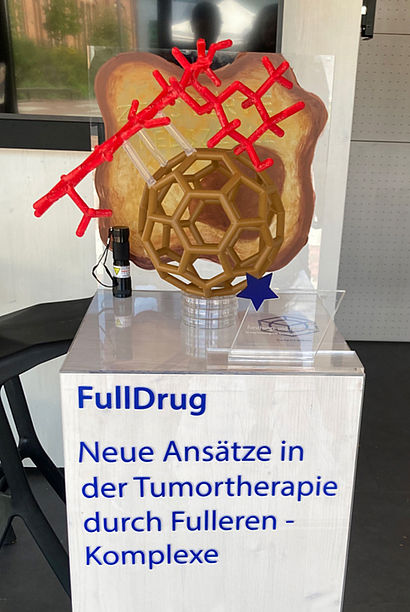
FullDrug | New Approaches to Cancer Therapy Using Fullerene ComplexesOpen areaClose area
This exhibit is currently on display at the Luckenwalde University Branch!
The “FullDrug” project combines photodynamic cancer therapy with chemotherapy: A drug complex consisting of fullerene nanoparticles and the chemotherapeutic agent doxorubicin is activated by specific light and, through a dual mechanism of action, leads to significantly faster cancer cell death.
You can find more information about the exhibit in this presentation.
Technical contacts:
Dr. Anna Grebinyk,
Prof. Dr. Marcus Frohme
May 2023 – September 2023
January 2024 – April 2024 at the Luckenwalde campus
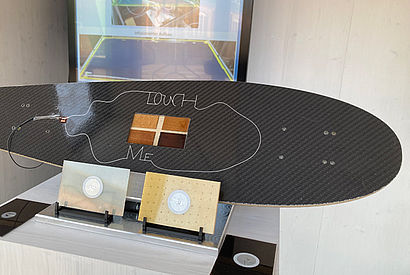
Skateboard | Demonstrator for Fiber-Reinforced Composite Material TechnologyOpen areaClose area
This exhibit is currently on display at the Luckenwalde University Extension Center!
The “skateboard” is a demonstrator developed by the Fiber Composite Materials Technologies research group led by Prof. Christian Dreyer in collaboration with Fraunhofer IAP’s PYCO research division. The team has incorporated the results of four different research projects into a single demonstrator—creating a skateboard and a longboard that visitors can touch and try out.
Technical contact:
Prof. Dr. Christian Dreyer
January 2023 – July 2023
August 2023 – November 2023, this exhibit will be on display at the Luckenwalde campus!
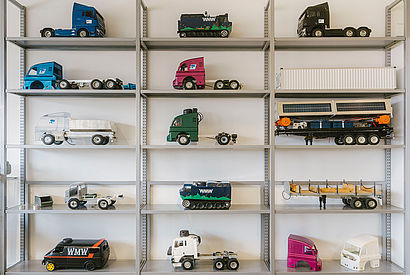
Autonomous Driving | Introducing Wildauer MaschinenwerkeOpen areaClose area
Wildauer Maschinen Werke (WMW) is the learning, research, and technology transfer platform for digital competencies at TH Wildau and a network of diverse degree programmes and research groups that come together to form a virtual case study within the context of an automotive engineering company. As part of the “Autonomous Driving” test bed, Prof. Stefan Kubica and his team are working to retrofit model trucks and other model vehicles—developed in-house at TH Wildau—for assisted and cooperative driving.
Technical contact persons:
Tobias Peuschke-Bischof,
Prof. Dr. Stefan Kubica
February 2023 – August 2023
ALERT | How Drones Can Help Fight WildfiresOpen areaClose area
The “ALARM” project aims to develop a comprehensive system consisting of multiple unmanned aerial vehicles, sensor technology, data acquisition and transmission, airspace surveillance, and air traffic control—a system specifically designed to provide aerial support for rescue and disaster relief operations while overcoming existing limitations.
Contact persons:
Prof. Dr. Wolfgang Rüther-Kindel
October 2022 – January 2023
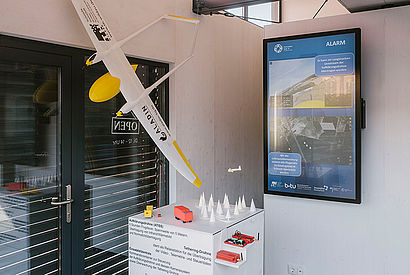
SAR-A | Development of a Model for an Automated Maritime Search and Rescue SysteOpen areaClose area
The acronym SAR-A stands for Search-and-Rescue Automation. This refers to a coordinated operation in air and maritime environments to
locate and rescue people in distress. The “– A” for automation means that humans do not need to be directly involved in the processes; rather, these processes occur autonomously.
Contact persons:
May 2022 – October 2022
Too close? - Staying back is safer!Open areaClose area
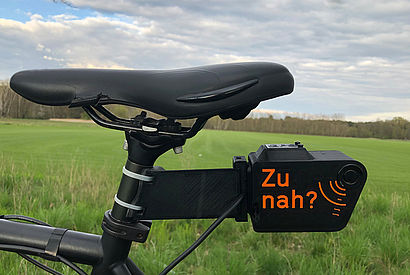
In 2022, Innovation Hub 13 and the research group on Cycling in Intermodal Transportation Networks collaborated with citizens to investigate the phenomenon of passing distances and subjective safety. Together with citizens from Brandenburg and Berlin, the passing distances between bicycles and cars were measured using the OpenBikeSensor to determine whether the minimum passing distance required by the German Road Traffic Regulations (StVO) was being observed.
Technical contact persons:
May 2022 – December 2022
AquaponicsOpen areaClose area
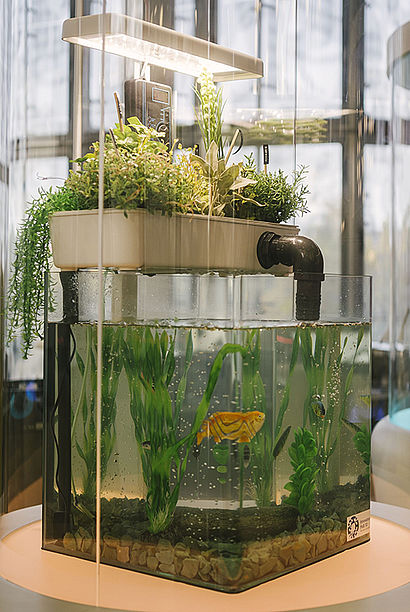
To raise awareness of the potential of aquaponics systems in the context of their research, the “Bioprocess Engineering” working group at the Technische Hochschule Wildau – Technical University of Applied Sciences and Innovation Hub 13 worked closely together in several phases to develop two models for presentation purposes. The result of this interdisciplinary collaboration is impressive—and even offers the opportunity to revolutionize regional food production.
Technical Contact Persons:
Prof. Dr. Franz Xaver Wildenauer (emeritus 02/23)
January 2022 – June 2022

Topics that might also be of interest to you:
- establishing research cooperations,
- invention disclosures and patents,
- or our scientific articles and publications.
Open Tuesday
Die ScienceBox ist geöffnet –
immer dienstags von 12 bis 14 Uhr.
Zentral auf dem Campus zwischen Haus 16 und Halle 17.
Kommen Sie vorbei und informieren Sie sich!
Ansprechperson
Dr. Sarah Schneider
+49 3375 508 498
+49 175 195 76 44 (Mobil)
sciencebox(at)th-wildau.de
Hochschulring 1, Haus 13, Raum 041, 15745 Wildau