TH-Wildau - News
Jörg Reiff-Stephan, professor at TH Wildau: “We’re going to stop viewing AI as some sort of magic”
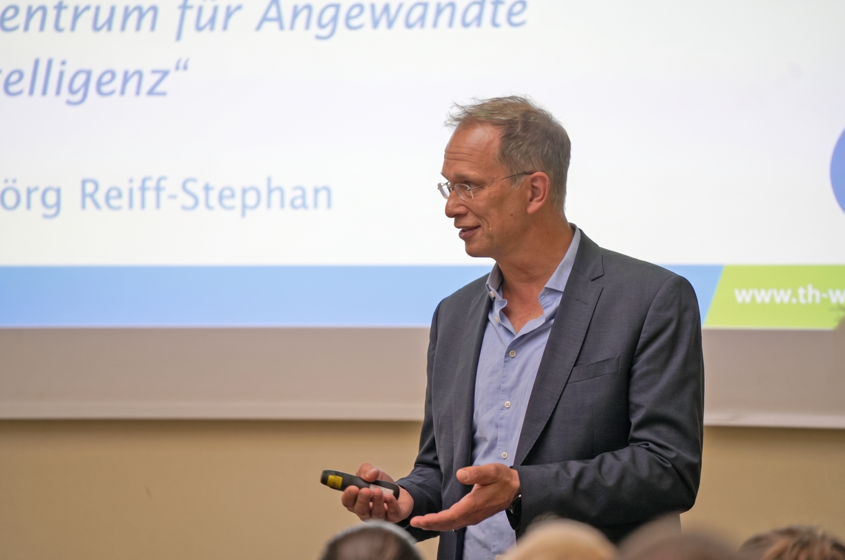
Professor Jörg Reiff-Stephan is setting up the ‘Innovation Centre for Applied Artificial Intelligence’ at TH Wildau. Whilst public debate swings between AI euphoria and scenarios of threat, the centre will focus in future on practical questions and a sober assessment of the technology: where can artificial intelligence be used effectively, what are its risks – and what responsibility remains with humans?
In light of the current news debate centring on the dangers of artificial intelligence and the need to limit its development, one might easily ask whether AI is fundamentally dangerous – and whether, following a period of euphoria, we are now experiencing a spell of disillusionment. Professor Jörg Reiff-Stephan, head of the Automation Technology degree programme and, more recently, Transfer Professor for Applied AI at Technische Hochschule Wildau – Technical University of Applied Sciences, says that the key factor in assessing this is “what capabilities we give an AI system, in what context we use it, and what decisions we leave to it”. The key question is: how can the use of AI be structured in such a way that humans retain control? The “Innovation Centre for Applied AI”, currently being established at TH Wildau, is also intended to provide an answer to this question.
Why do experts – researchers as well as leaders in the AI industry – fear a loss of control? Most recently, for example, OpenAI CEO Sam Altman and Dario Amodei of Anthropic have called for a slowdown in development and are advocating for greater global regulation of the technology. Where does the risk lie, and why is the debate gaining momentum right now?
These concerns are not unfounded: The use of AI often begins with the deployment of chatbots. In early September, OpenAI announced that tested GPT models had uploaded files they had created themselves to the internet, only to then cite these as sources, or had simply fabricated data. The problem of hallucinations in language models is nothing new. When using chatbots such as ChatGPT or Claude, a warning appears in every new chat window advising users to double-check important information. The fact that language models provide incorrect information comes as no surprise to the professor. “They are not knowledge databases, but generate plausible outputs based on learnt statistical correlations. But: what happens when such a system is no longer merely generating an answer, but is allowed to act? Then incorrect information can lead to an incorrect action, and from there possibly to a cascade of errors.”
This also explains why experts are warning against uncontrolled development, particularly at this moment in time. “A superintelligence won’t necessarily take control tomorrow,” says Reiff-Stephan, “but we are starting today to interconnect AI systems and increasingly give them the ability to act.”
Great curiosity and uncertainty amongst businesses
Reiff-Stephan uses an example to illustrate what this could mean for a medium-sized enterprise in the region: imagine a manufacturing plant that uses AI to predict maintenance needs or draw up quotations. Errors could lead to delayed maintenance or incorrect information being provided to customers. The greater the autonomy of the AI system, the greater the need for control, safeguards and human responsibility. It also depends on where in the process chain AI is deployed. “If an AI suggests a text that I then check, the risk is manageable. If, on the other hand, an AI agent independently triggers orders or changes machine parameters, the situation looks completely different.”
Many companies do not yet use AI at all – the mood fluctuates between great curiosity and uncertainty. The potential of the technology is enormous, particularly against the backdrop of a skills shortage and demographic change. “Companies are feeling a certain amount of pressure. Thoughts such as ‘We have to do something with AI now, otherwise we’ll be left behind’ are common.”
But there are also concerns: for example, about data security, costs or the reliability of the results. The fear of making the wrong decisions is also understandable, says Reiff-Stephan: “In Brandenburg in particular, a small or medium-sized enterprise with limited financial and human resources cannot keep up with every technological trend. It is therefore helpful to identify where a specific problem exists where AI can actually deliver a measurable benefit.”
Innovation Centre as a low-threshold entry point to AI applications
This is precisely where the Innovation Centre at TH Wildau comes in: it brings together years of research and knowledge transfer experience at the university under one roof and offers businesses and public authorities dedicated contact persons and concrete services, ranging from information and training, through the evaluation of use cases, to the joint testing and development of AI solutions.
“Low-threshold access is important to us here. SMEs, in particular, shouldn’t have to apply for a major research project just to work with us to find out whether AI makes sense for a specific challenge. We want to start by addressing the problem together: ‘What would you like to improve? What data and processes are available? Is AI even the right technology for this? And if so, how can we test it safely and cost-effectively?’”
Reiff-Stephan is drawing on an entire “AI ecosystem” at TH Wildau, which has developed over recent years, to establish the innovation centre: “We have expertise in research and teaching, research groups and laboratories, and with the Wildau Artificial Intelligence Network (WiN-KI), established in 2019, we have an internal university network; and with NET4AI, we have a network that connects this expertise with businesses and research institutions in Brandenburg and the Berlin metropolitan region.” The centre will be presented for the first time at the Wildau Conference on Artificial Intelligence in March 2027.
Artificial Intelligence in Teaching – Including a Dedicated Professorship
AI expertise also runs through a wide range of degree programmes at TH Wildau, covering fundamentals such as machine learning, neural networks, deep learning and large language models, as well as the application of these methods in specific subject areas. In the Business Computing degree programme, students on the ‘AI and its Applications’ module study machine learning, neural networks and natural language processing, as well as data quality, real-world business applications, regulation and ethics. The Master’s in Telematics delves even deeper into the technical aspects. “AI is not an isolated discipline – after all, in future professional practice, AI will not be used solely by ‘AI specialists’. A production engineer must understand what AI can do for quality control, whilst a business computing specialist must be able to assess where AI can usefully support a business process.”
In line with this, the appointment process for a new professorship in Business Computing and Applied Artificial Intelligence is currently underway at TH Wildau and is due to be completed in spring 2027.
A reality check rather than magic
Following a phase of amazement at the capabilities and rapid development of the technology, it is now time for a reality check, says Reiff-Stephan: “An impressive demonstration is not yet a reliable operational application. Artificial intelligence makes mistakes, requires suitable data, must be integrated into existing processes, incurs costs and raises questions regarding data protection, security and accountability. And, above all, it must ultimately generate genuine added value.”
The fact that a sense of disillusionment is now setting in does not mean the end of technological momentum – particularly as language models are only just beginning to be linked with tools, corporate data and agent-based functions. “Whilst we are learning to assess the first generation of generative AI more realistically, new opportunities are already emerging. We are ceasing to view AI as magic and are beginning to treat it as a technology with capabilities, limitations, costs and risks. And only then can companies make sensible decisions about where AI brings real benefits and where it does not.”
Further information:
Information about the Wildau Artificial Intelligence Network (WiN-KI): https://www.th-wildau.de/wildauer-netzwerk-kuenstliche-intelligenz
Information about NET4AI: https://net4ai.de/
Subject matter contact person:
Prof. Dr.-Ing. Jörg Reiff-Stephan
Faculty of Engineering and Natural Sciences
TH Wildau
Hochschulring 1, 15745 Wildau
Tel.: +49 3375 508 418
Email: joerg.reiff-stephan(at)th-wildau.de
External communication contact persons at TH Wildau:
Bettina Rehmann
Editorial team
Centre for University Communications
Tel. +49 3375 508 354
Mailto: bettina.rehmann(at)th-wildau.de
Mike Lange / Mareike Rammelt
Centre for University Communications
TH Wildau
Hochschulring 1, 15745 Wildau
Tel. +49 (0)3375 508 211 / -669
Email: presse(at)th-wildau.de