TH-Wildau - News
Brandenburg honours international and European commitment for the 25th time – Prof. Dr Marcus Frohme of TH Wildau receives the European Certificate
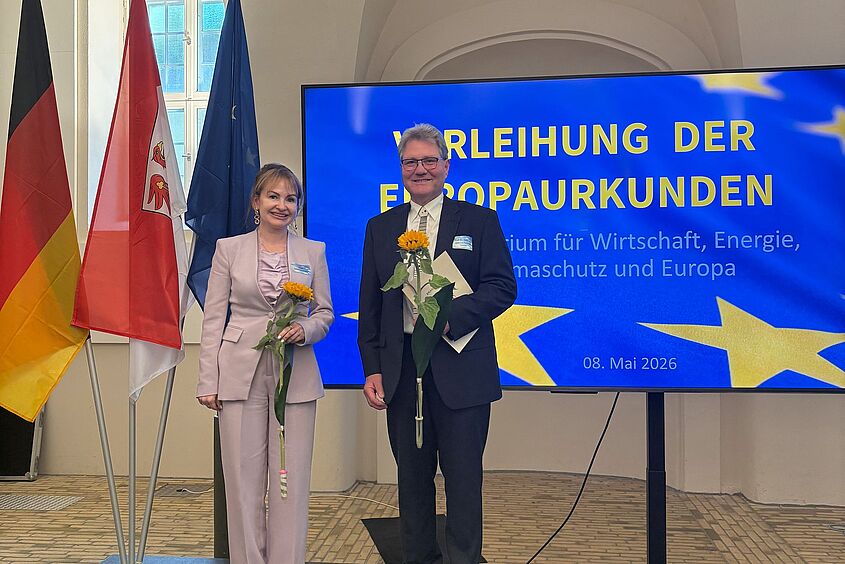
Presentation of the European Certificates in Potsdam: Last week, State Secretary Hendrik Fischer, acting on behalf of Martina Klement, Minister for Economic Affairs, Energy, Climate Protection and Europe, honoured the award winners for their commitment to European cooperation. Prof. Frohme from the TH Wildau received one of the Examinations Certificates for his many years of commitment to German-Ukrainian cooperation and academic bridge-building.
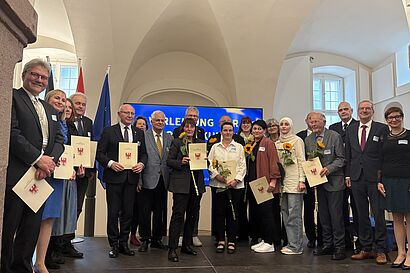
A total of 14 individuals, initiatives and organisations were presented with a European Certificate last week in the historic vaulted hall of the Brandenburg Museum for the Future, the Present and History in Potsdam, in recognition of their commitment to the European ideal in the state of Brandenburg. On the occasion of the 25th anniversary of the European Certificate, this commitment deserves special recognition at a time when European cohesion is facing increasing challenges. State Secretary Hendrik Fischer honoured the award winners from Brandenburg and Poland for their efforts to promote European cooperation. Prof. Dr Marcus Frohme, holder of a research professorship, head of the Department of Molecular Biotechnology and Functional Genomics and Chairperson of the Senate at Technische Hochschule Wildau – Technical University of Applied Sciences (TH Wildau), received one of the Examinations Certificates for his commitment to German-Ukrainian cooperation and academic bridge-building.
Together with his team led by Dr Alina Nechyporenko, professor of Computer Science in Kharkiv and staff member at TH Wildau since 2019, Prof. Frohme has carried out various projects in Ukraine over the past few years.
“I am, of course, delighted to receive such an award, as it highlights our work with and for Ukraine and thereby indirectly expresses the political will to support the country under attack. I see this recognition above all as a tribute to the work of my team over several years, with a changing line-up, but above all to Prof. Nechyporenko, who was in charge of the operational management of all projects, whilst I devised strategies and structures and secured funding,” said Prof. Frohme on receiving the award.
From German-Ukrainian summer schools to the Wildau Welcome IT Bridge
It all began in 2021 with German-Ukrainian summer schools, which were funded by the German Academic Exchange Service (DAAD). With the start of Russia’s war of aggression in 2022, cooperation intensified in order to maintain academic operations in Ukraine. Thus, with financial support from the State of Brandenburg, the Wildau Welcome IT School was launched as early as May 2022, offering a fully organised semester for refugee students from Ukraine. The aim was to support the Ukrainian students and provide them, at least temporarily, with prospects, an education and a sense of home. Some of the students are now employed by IT companies in Berlin, and two of the graduates are working at TH Wildau.
The launch of the Wildau Welcome IT Bridge in July 2022 established an innovative digital framework designed to enable Ukrainian students to continue their degree programmes in the field of IT and to support Ukrainian lecturers. The project series was made possible largely by the DAAD and the Harald Christ Foundation for Democracy and Diversity. Over 150 lecturers from Ukraine were recruited in total, and over four years there were around 12,000 registrations of students for the more than 450 modules on offer. Prof. Frohme has clear ideas about how things should proceed in the future:
“Firstly, our cooperation with our partner university, the National University of Radio Electronics in Kharkiv, is set to continue through the joint degree programme CoSMoS-NT until at least 2029 – and we also expect to strengthen our research cooperation with our partners. However, there are also ideas – as became clear during informal discussions – to place the cooperation in the Kharkiv region on a broader footing, extending beyond the academy. Preliminary talks on this are now underway. First, however, we are organising the Ukraine Days in the autumn. There is also a much longer-standing collaboration with Al-Quds University in Palestine, which I would like to expand, and there are also plans regarding Syria and India. And if I find the time, I would like to pursue continuing education in the field of science diplomacy,” said Prof. Frohme, looking ahead.
Background to the 2026 Europe Weeks
The Council of Europe was founded on 5 May 1949. It is Europe’s leading human rights organisation and has 46 member states representing over 700 million Europeans. The European Union celebrates ‘Europe Day’ every year on 9 May to mark the ‘Schuman Declaration’ of 9 May 1950. In it, the then French Foreign Minister proposed the creation of a European Coal and Steel Community, from which today’s European Union ultimately developed.
The Europe Weeks take place on the initiative of the German federal states in cooperation with the European Commission, the European Parliament and the Federal Government. The European Affairs Ministers and European Affairs Senators of the federal states decide on the exact dates each year at the Conference of European Affairs Ministers (EMK). A new development since 2023 is the introduction of “Europe Weeks”. These begin on 30 April and end on 31 May.
The aim is to familiarise citizens with the topic of Europe and the European Union through a diverse range of local information and discussion events, and to promote political dialogue on the European integration process and the associated changes.
The programme of events is planned individually in each federal state. In Brandenburg, this traditionally includes the presentation of the European Certificates.
Further information
Information on the new CoSMoS-NT degree programme project: https://www.th-wildau.de/thinsights/neuer-deutsch-ukrainischer-ki-studiengang
Information on the Wildau IT Bridge: https://www.th-wildau.de/university/current news/solidaritywithukraine/wildau-welcome-it-school
Information on Prof. Frohme’s Department of Molecular Biotechnology and Functional Genomics: https://www.th-wildau.de/forschung-und-transfer/forschung/forschungsschwerpunkte/institute-of-life-sciences-and-biomedical-technologies/molbiotec (in German)