TH-Wildau - News
Accessibility and inclusive experiences in museums – launch of the EU project AIMused with the participation of TH Wildau
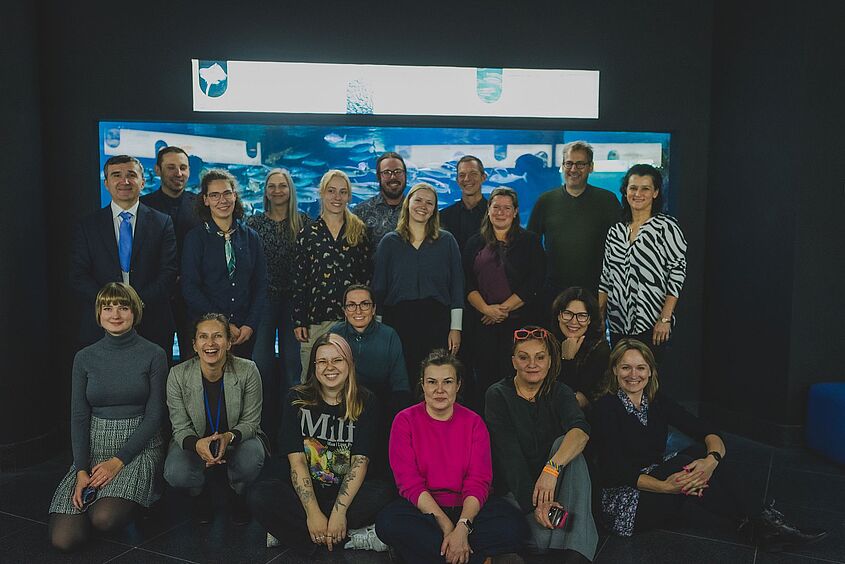
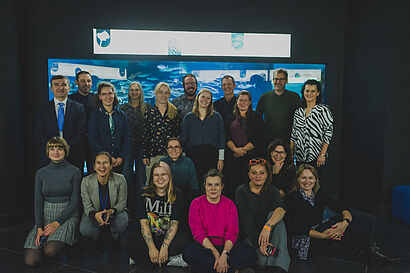
The EU project AIMused kicked off at the end of October with a launch event at the NMFRI Gdynia Aquarium maritime museum in Poland. The project focuses on accessibility and inclusive experiences in museums and the development of recommendations for action for relevant institutions. TH Wildau will support the consortium from Poland, Lithuania, Denmark, Sweden and Germany in knowledge management and the production of physical prototypes.
How can barrier-free access to museums be made possible for certain groups of people while at the same time creating inclusive experiences for all visitor groups? This is the focus of the ‘AIMused’ project, which kicked off on 27 October 2025 at the NMFRI Gdynia Aquarium marine museum in Poland. As a project partner, the TH Wildau - Technical University of Applied Sciences (TH Wildau) will support the consortium from Poland, Lithuania, Denmark, Sweden and Germany in knowledge management and the production of physical prototypes. In addition to aquariums, museums and universities, the Polish company Nautil, which advises organisations on digital and physical accessibility, and KL Kulturland MV gGmbH are also involved. The non-profit organisation from Mecklenburg-Western Pomerania advises cultural professionals on issues of inclusion and diversity.
Goal: An inclusive experience for all visitors
Over the next three years, the project partners want to work with people who have special needs in order to find new approaches to museum work. These people have conditions such as attention deficit disorder, dyslexia or visual and hearing impairments. The project is based on the universal design approach, which is increasingly being used in museums. This approach also focuses on the very specific needs of individual groups of people when developing visitor services in order to offer added value for all users. Examples include haptic elements for visually impaired people, which can then be used by all museum visitors. Although numerous technological and conceptual solutions are already available on the market, there is a lack of overview and shared application experience with those affected in order to offer an inclusive experience for visitors in line with universal design principles. The limited resources of museums also play a role in this.
What are the next steps?
First, there will be an intensive phase of data collection on the needs and technologies used by the target group. In this process, the project partners will also determine which technological solutions for accessibility are generally available, e.g. AI tools for automated, personalised audio descriptions or simple language and 3D printing for haptic experiences of artefacts. Selected solutions will then be adapted and tested by the museum partners. "The knowledge gained will be made available to other museums. We will work on this throughout the entire project period. The partners are also very interested in the opportunities offered by our Wildau makerspace “Vinn:Lab” – both for creating their own prototypes and for getting to know the available technologies before purchasing their own equipment," explains Prof. Susanne Marx, who is leading the project at the TH Wildau - Technical University of Applied Sciences.
Project partners and project duration
The project partners of AIMused are the NMFRI Gdynia Aquarium in Poland, consortium leader and lead partner, the University of Szczecin in Poland, the Lithuanian Sea Museum in Lithuania, NaturBornholm in Denmark, the TH Wildau - Technical University of Applied Sciences in Germany, the Kalmar County Museum in Sweden, KL Kulturland MV gGmbH in Germany, Nautil – Leszek Chojnicki in Poland, and eleven associated partners from Denmark, Germany, Sweden, Lithuania and Poland.
AIMused is co-financed by the European Regional Development Fund (ERDF) under the Interreg South Baltic Programme 2021–2027. The ERDF co-financing amounts to €1,661,574.20. The project will run from 18 September 2025 to 18 August 2028 and has a total budget of €2,076,967.75.
Further information
Further information on the AIMused project at TH Wildau is available from Prof. Susanne Marx.
Further information on the ViNN:Lab at TH Wildau is available at www.th-wildau.de/vinnlab
Project contact at TH Wildau:
Prof. Susanne Marx
Professor of General Business Administration, specialising in project management
AIMused project
TH Wildau
Hochschulring 1, 15745 Wildau
Phone: +49 (0)3375 508 342
Email: susanne.marx(at)th-wildau.de
External communications contacts at TH Wildau:
Mike Lange / Mareike Rammelt
TH Wildau
Hochschulring 1, 15745 Wildau
Phone: +49 (0)3375 508 211 / -669
Email: presse(at)th-wildau.de